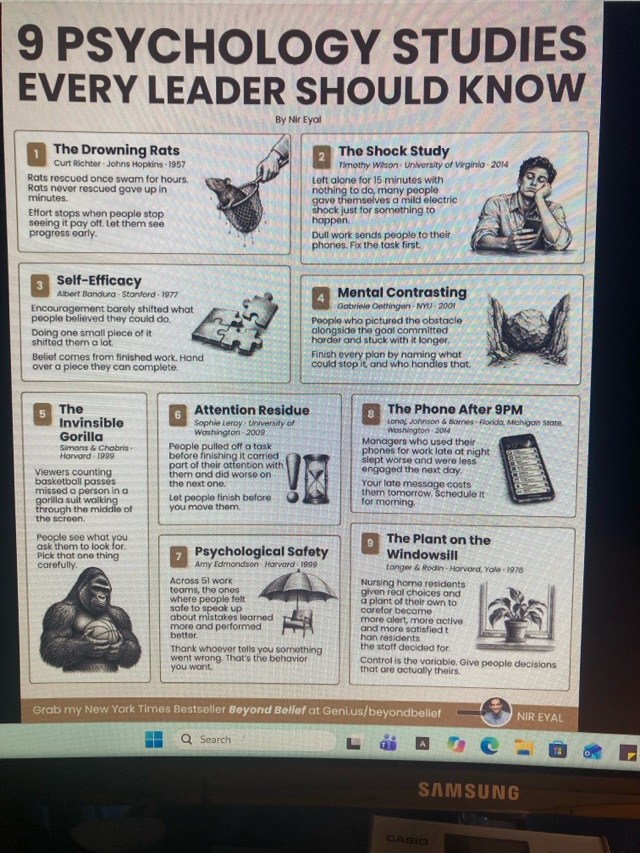
9 Psychology Studies Every Leader Should Know — by Nir Eyal
1. The Drowning Rats
Rats rescued once swam for hours. Rats never rescued gave up in minutes.
Effort stops when people stop seeing it pay off. Let them see progress early.
2. The Shock Study
Left alone for 15 minutes with nothing to do, many people gave themselves a mild electric shock just for something to happen.
Dull work sends people to their phones. Fix the task first.
3. Self-Efficacy
Encouragement barely shifted what people believed they could do. Doing one small piece of it shifted them a lot.
Belief comes from finished work. Hand over a piece they can complete.
4. Mental Contrasting
People who pictured the obstacle alongside the goal committed harder and stuck with it longer.
Finish every plan by naming what could stop it and who handles that.
5. The Invisible Gorilla
Viewers counting basketball passes missed a gorilla suit walking through the middle of the screen.
People see what you ask them to look for. Pick that one thing carefully.
6. Attention Residue
People pulled off a task before finishing it carried part of their attention with them and did worse on the next one.
Let people finish before you move them.
7. Psychological Safety
Across 51 work teams, the ones where people felt safe to speak up about mistakes learned more and performed better.
Thank whoever tells you something went wrong. That's the behavior you want.
8. The Phone After 9PM
Managers who used their phones for work late at night slept worse and were less engaged the next day.
Your late message costs them tomorrow. Schedule it for morning.
9. The Plant on the Windowsill
Nursing home residents given real choices and a plant of their own to care for became more alert, active and satisfied than residents the staff decided for.
Control is the variable. Give people decisions that are actually theirs.